Matt Strong
CS PhD student in Robotics and AI, Stanford University · NSF Graduate Research Fellow

I’m a Computer Science PhD in Robotics and AI at Stanford University. I am currently advised by Monroe Kennedy and Jeannette Bohg. I am interested in data-efficient 3D vision and tactile sensing for robotics, and in vision-only autonomous driving. I am generously funded by the National Science Foundation Graduate Fellowship.
Prior to this, I worked at Microsoft as a Software Engineer in Redmond on the Customer Experience Platform. Before this, during my undergrad at the University of Colorado Boulder, I worked in the HIRO group as an undergraduate researcher, advised by Professor Alessandro Roncone. I was also a researcher in the SBS lab, advised by Professor Wangda Zuo.
I also enjoy teaching, and I received the Stanford Centennial Teaching Award — you can read the spotlight here.
I enjoy running, basketball (following+playing), driving my Corolla, frisbee, lifting, Beat Saber, and hiking. Check out my Strava!
My best languages: Python, C++, Typescript, C#, 中文 (in progress)
Selected Work
Real2Sem2Real: 3D Semantic Augmentations for Robot Learning from a Single Human RGB Demonstration
In submission, October 2026
Real2Sem2Real turns one monocular RGB video of a human demonstration into thousands of robot demonstrations across the object instances of a category: it tracks each object with DINOv3-distilled Gaussian splats, aligns digital cousins to the demonstration semantically, and carries the human grasp over to every cousin. Vision-language-action policies trained on its data match or exceed teleoperation on two real robots and four tasks.
VisTacAlign: Co-Training Dexterous Policies on Tactile Human and Robot Demonstrations
arXiv, September 2026
VisTacAlign co-trains 3D-visual-tactile dexterous policies on human and robot demonstrations by closing the human-robot gap in every modality: glove-tracked hand motion is retargeted to the robot hand, the human hand is replaced by the robot hand in the point cloud, and tactile glove signals are aligned to the robot fingertip sensors.
Learning to Drive is a Free Gift: Large-Scale Label-Free Autonomy Pretraining from Unposed In-The-Wild Videos
IEEE/CVF Conference on Computer Vision and Pattern Recognition (CVPR), June 2026
LFG learns a unified pseudo-4D representation of geometry, semantics, motion, and short-term future evolution directly from unposed, unlabeled single-view driving videos, reaching state-of-the-art planning with a single front camera.
TensorTouch: Calibration of Tactile Sensors for High Resolution Stress Tensor and Deformation for Dexterous Manipulation
IEEE Transactions on Robotics (T-RO), April 2026
TensorTouch is a comprehensive framework for stress tensor estimation from 3D optical tactile sensors, combining finite element analysis with deep learning to extract detailed contact information including stress tensors, deformation fields, and force distributions at pixel-level resolution.
DexFruit: Dexterous Manipulation and Gaussian Splatting Inspection of Fruit
IEEE Robotics and Automation Letters (RA-L), December 2025
DexFruit is a robotic manipulation framework that enables gentle, autonomous handling of fragile fruit using optical tactile sensing and introduces FruitSplat, a novel technique to represent and quantify visual damage in high-resolution 3D via Gaussian Splatting.
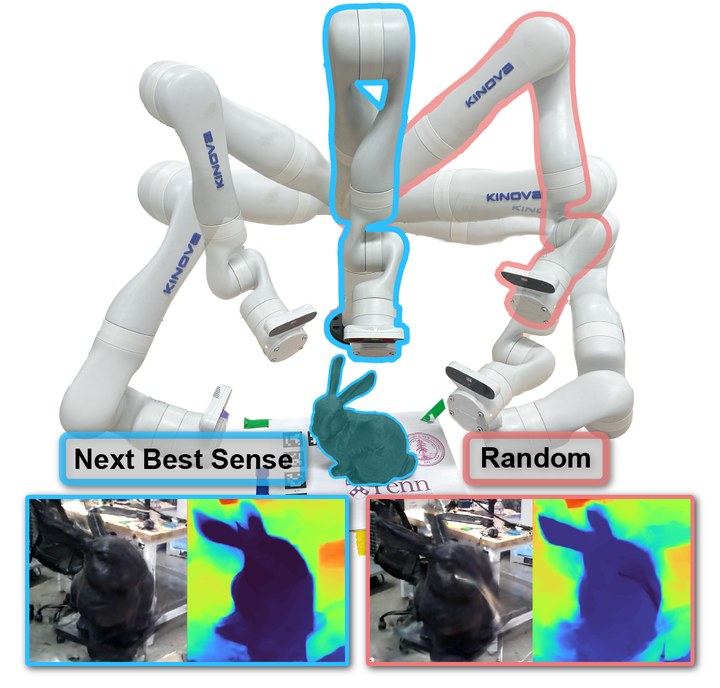
Next Best Sense: Guiding Vision and Touch with FisherRF for 3D Gaussian Splatting
IEEE International Conference on Robotics and Automation (ICRA), May 2025 Oral
Next Best Sense draws upon state of the art vision models to train few-shot Gaussian Splatting scenes, and turns to impressive next best view selection methods to guide robotic manipulator next best view and touch selection in the wild.
J-PARSE: Jacobian-based Projection Algorithm for Resolving Singularities Effectively in Inverse Kinematic Control of Serial Manipulators
ArXiv, May 2025
J-PARSE is a method for smooth first-order inverse kinematic control of serial manipulators near kinematic singularities, expanding the available workspace for applications in servoing, teleoperation, and learning.
Touch-GS: Visual-Tactile Supervised 3D Gaussian Splatting
IEEE/RSJ International Conference on Intelligent Robots and Systems (IROS), October 2024 Oral
Touch-GS combines the power of vision and touch to generate high-quality few-shot and challenging scenes, such as few-view object centric scenes, mirrors, and transparent objects.