Agentic change detection: results so far
Snapshot of Nov 9, 2026. Blue bars with bold labels are ours, grey bars are baselines, hatched bars are ablations or upper bounds. Tap a chart for the full-size image. Charts marked partial are still running and will be updated.
Files: results.csv (every number in the charts) and the source tables: 3DGS-CD per scene, SceneDiff per pair, object results, scene update, edit ladder, robot pick-and-place, runtime on SceneDiff, PASLCD and 3DGS-CD.
Headline numbers (Nov 10)
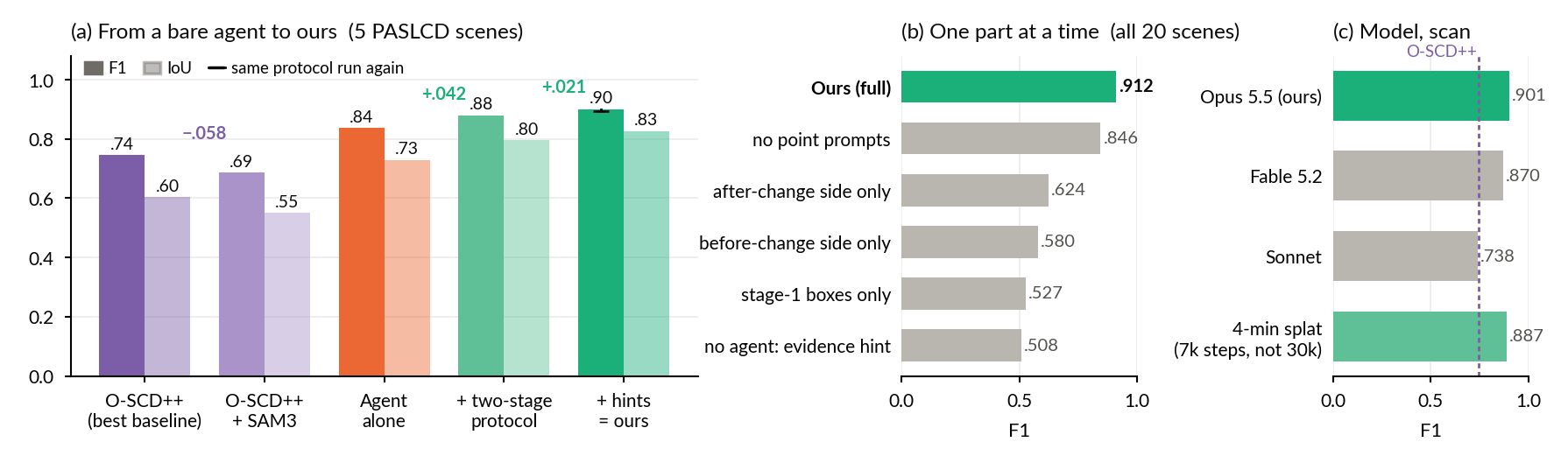
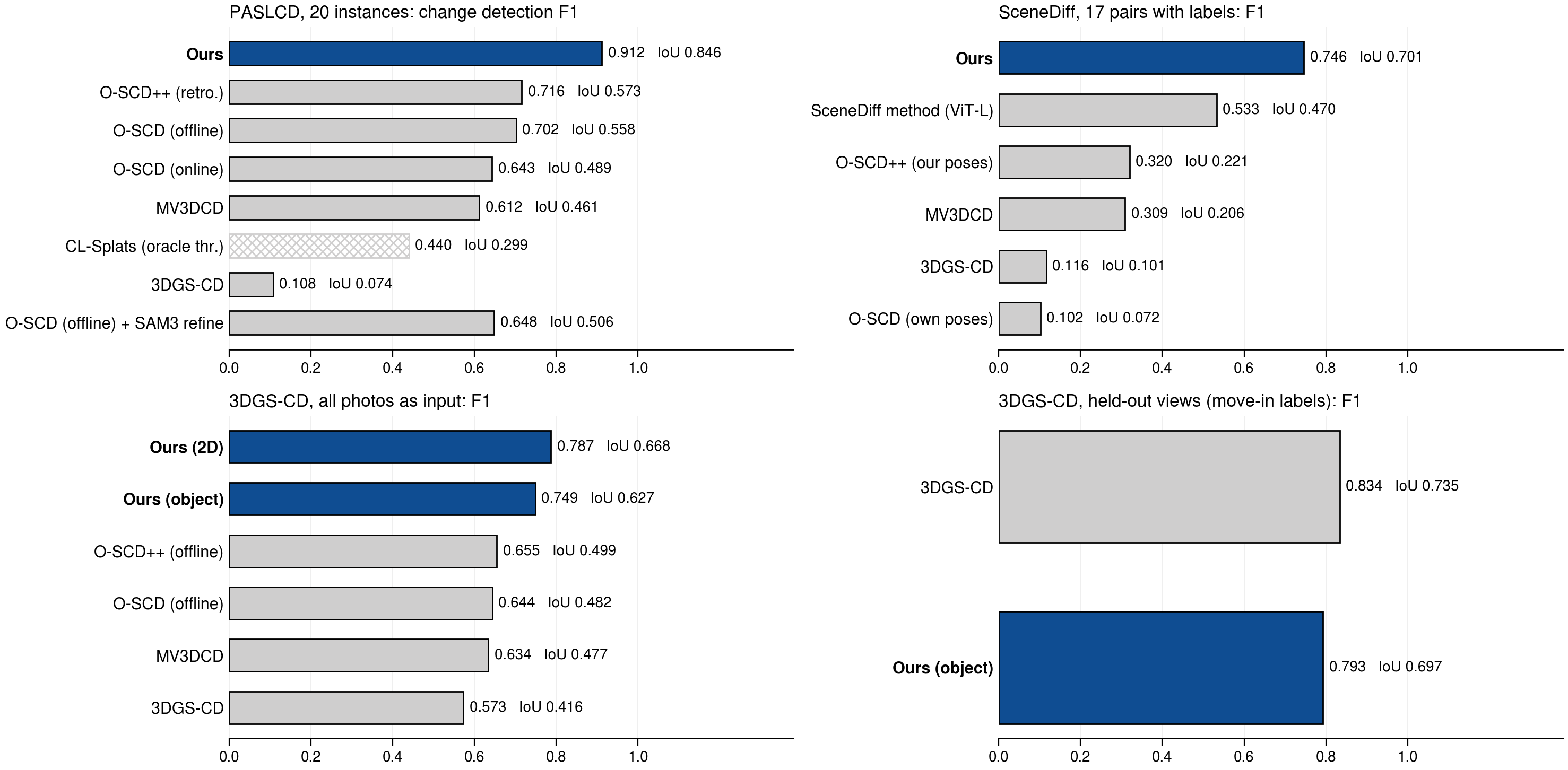
- Change detection, F1: PASLCD ours .912 vs O-SCD++ .716 (all 20) · SceneDiff .746 vs SceneDiff's method .533 · 3DGS-CD all photos .787 vs O-SCD++ .655 · our one loss: 3DGS-CD held-out views .793 vs 3DGS-CD .834.
- Agent vs protocol (5 PASLCD scenes): a bare agent (render + photo only) gets .837, already above O-SCD++ .745; our protocol adds +.064 (.901). Repeat run .892; a 4-minute splat instead of the 75-minute one: .887.
- Can O-SCD be rescued? Five SAM3 / DINO refinements of its masks: none beats raw O-SCD (best .648 vs .702 on 20 scenes; ours .912).
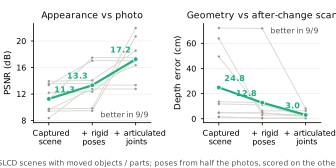
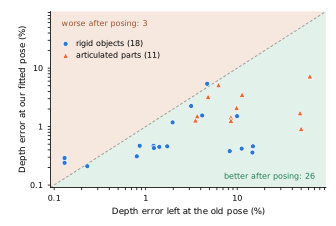
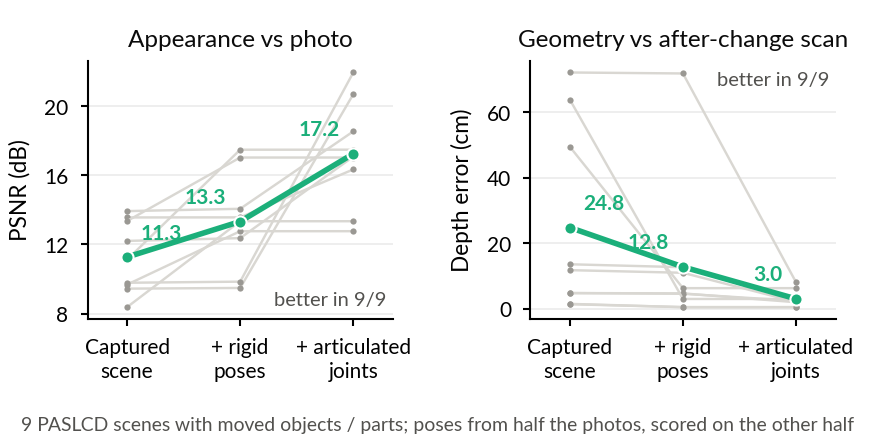
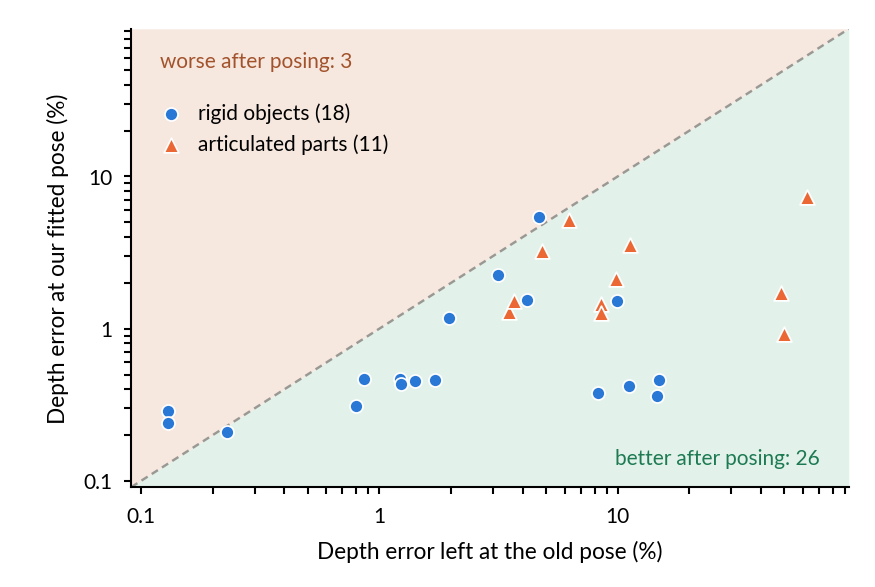
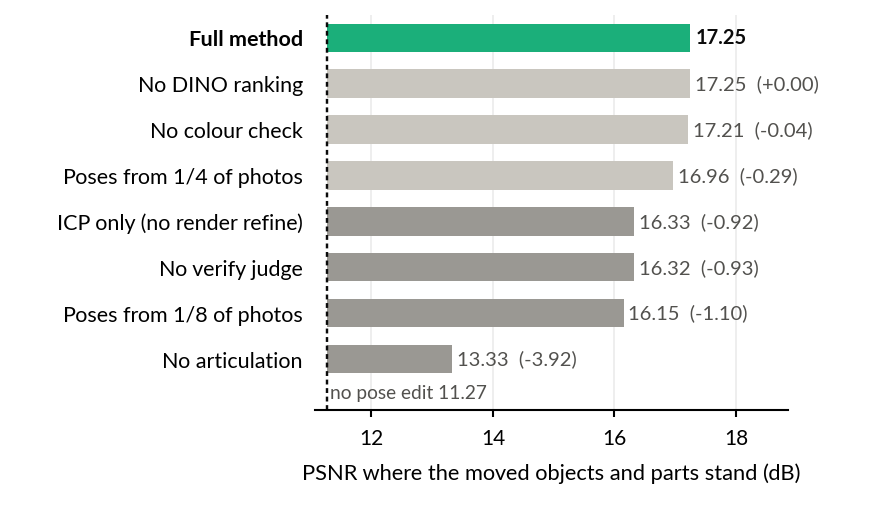
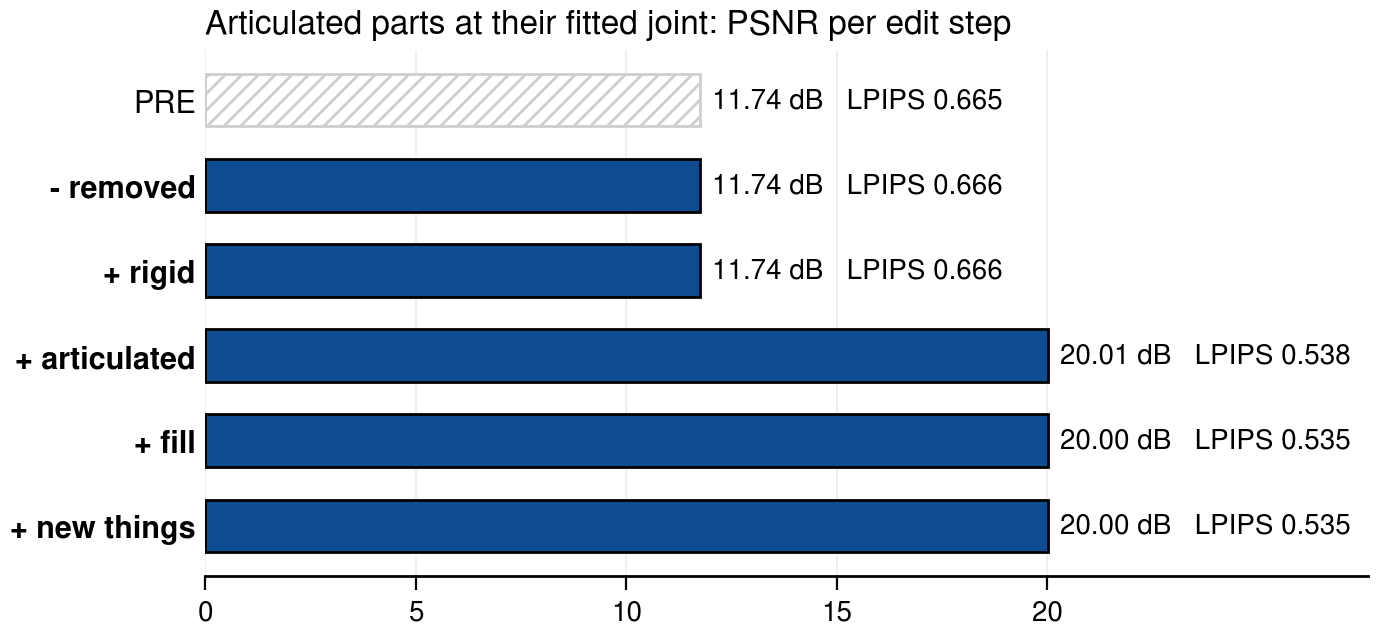
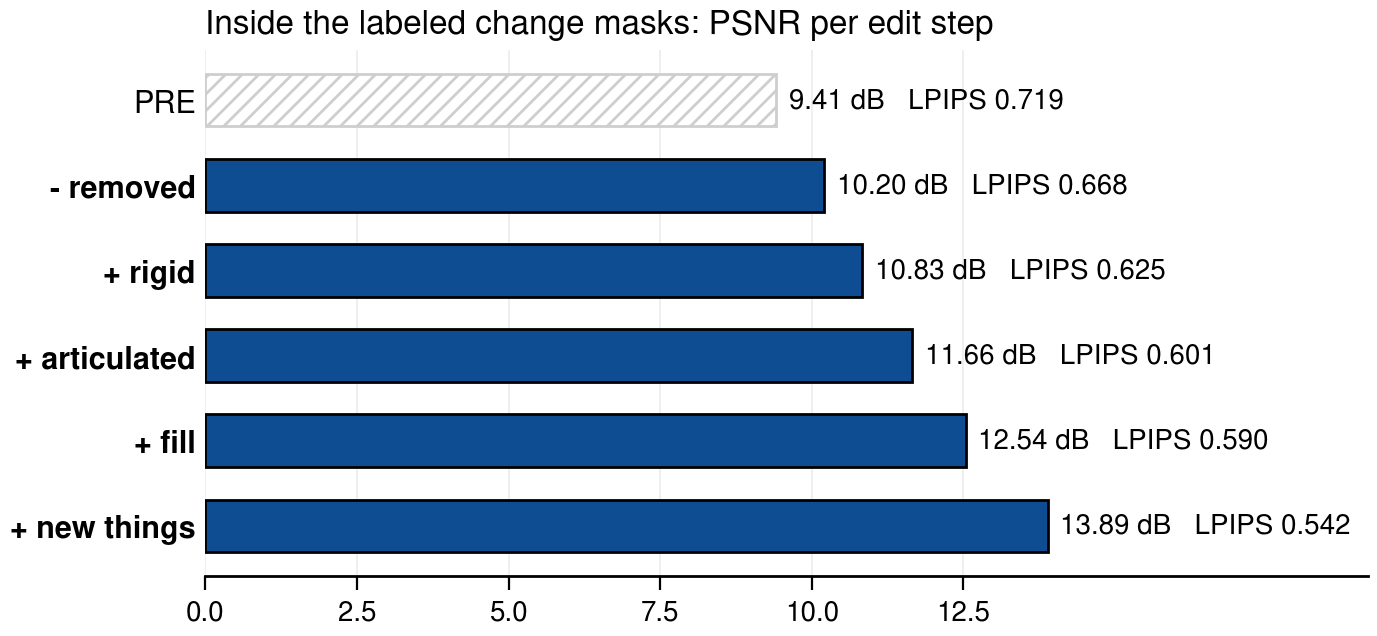
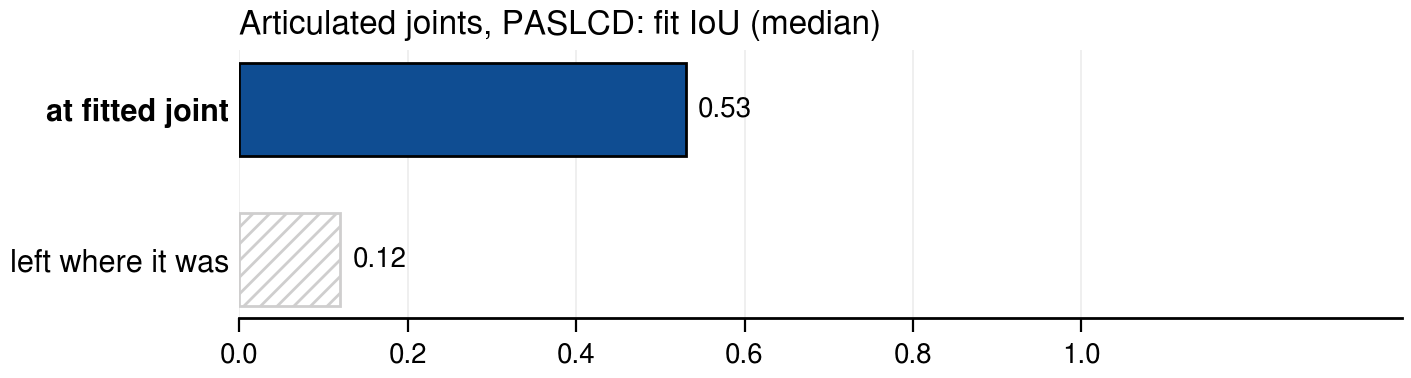
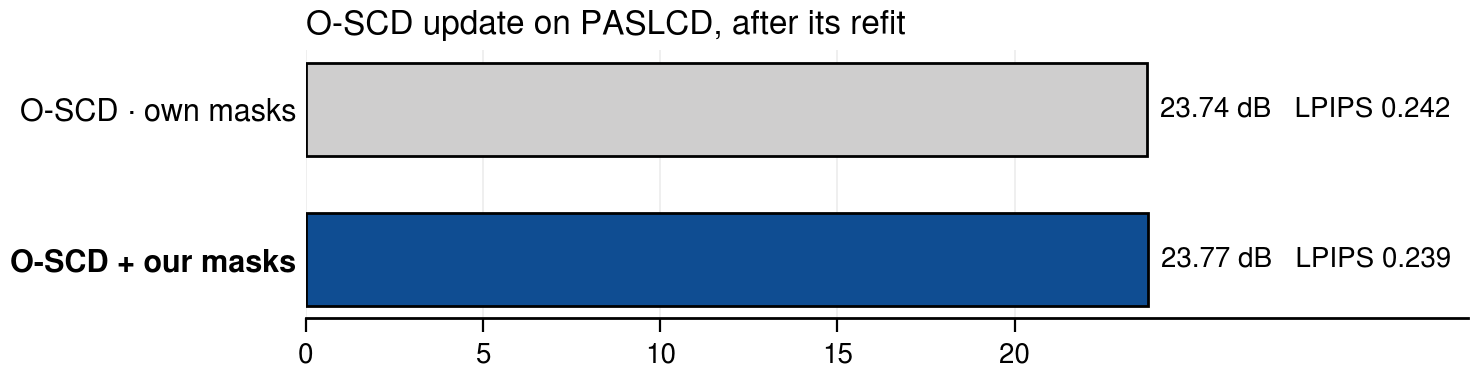
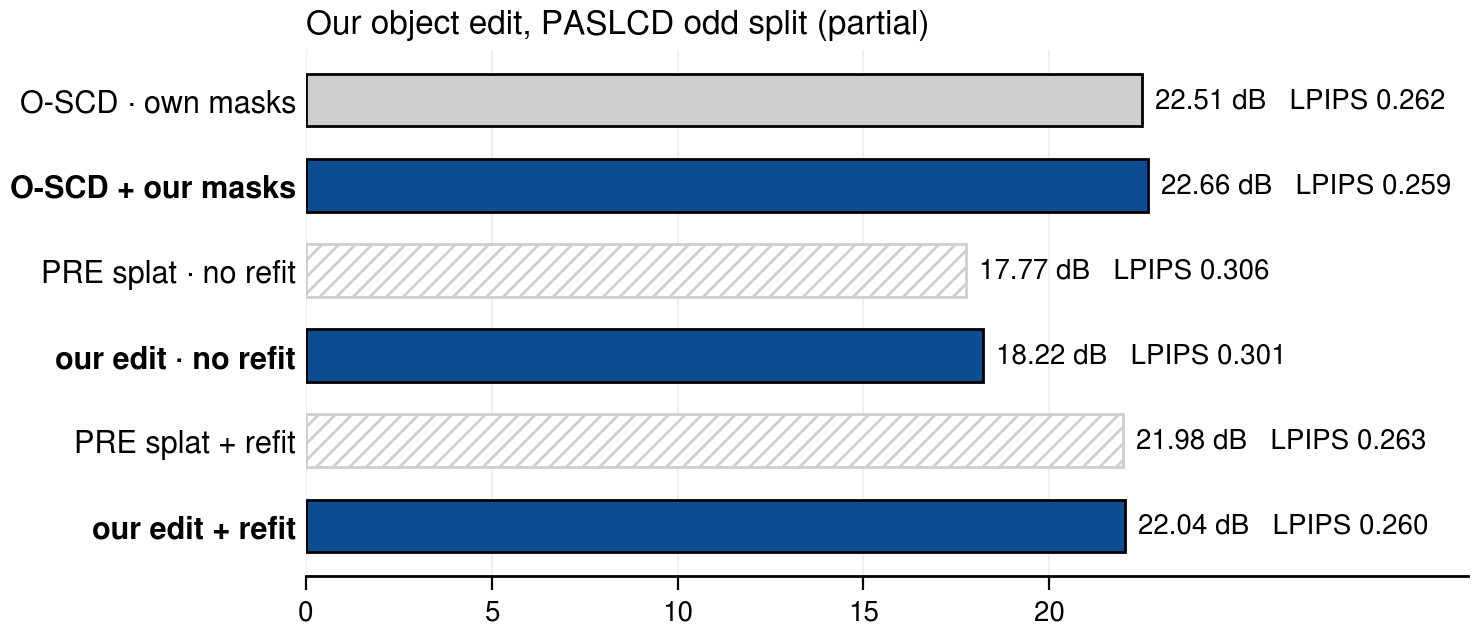
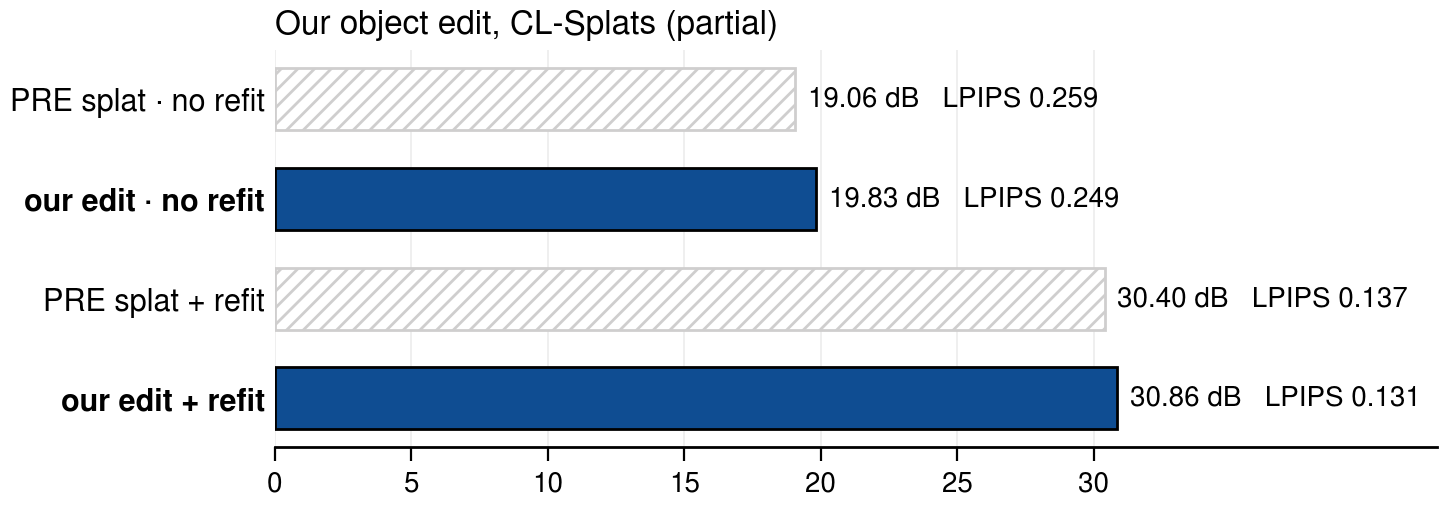
- Object poses (poses from half the photos, scored on the other half): depth error where moved objects and parts stand 10.2 % (24 cm) → 1.8 % (3.0 cm), better in 9/9 scenes; rigid 0.76 %, articulated 3.0 %; 26 of 29 objects better. 3DGS-CD's edit on the same base splat: 12.5 %. O-SCD (after its photo refit) ties our appearance there; same-representation O-SCD run in progress.
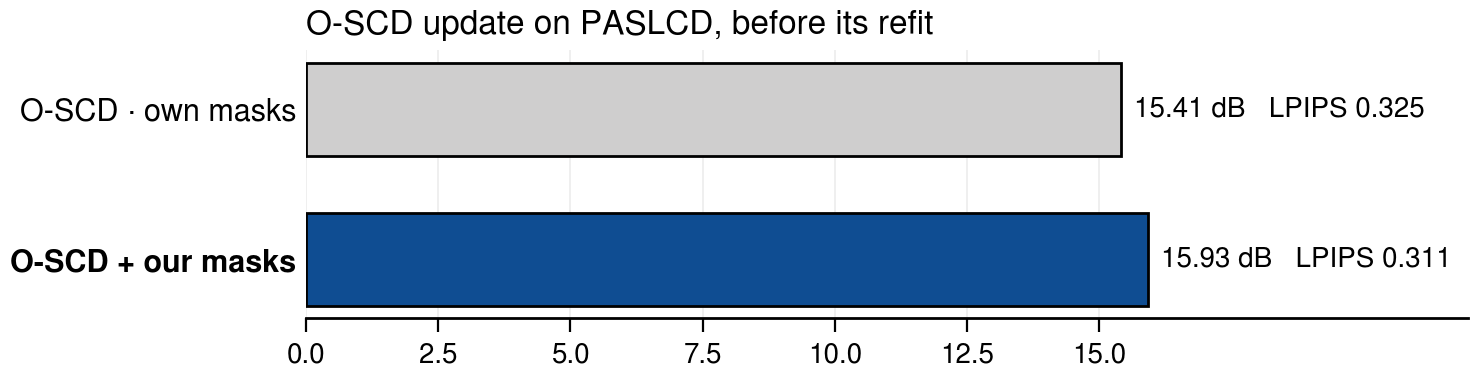
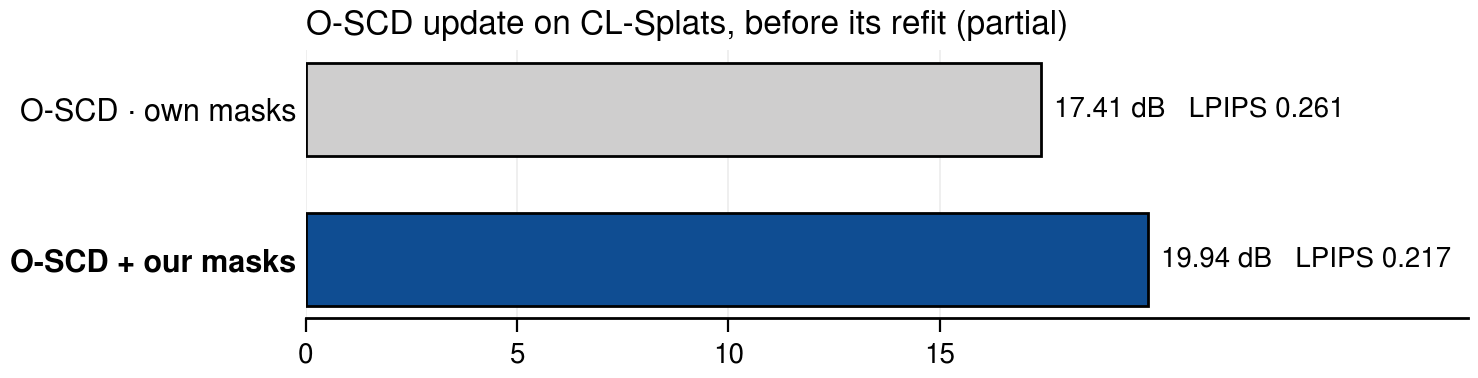
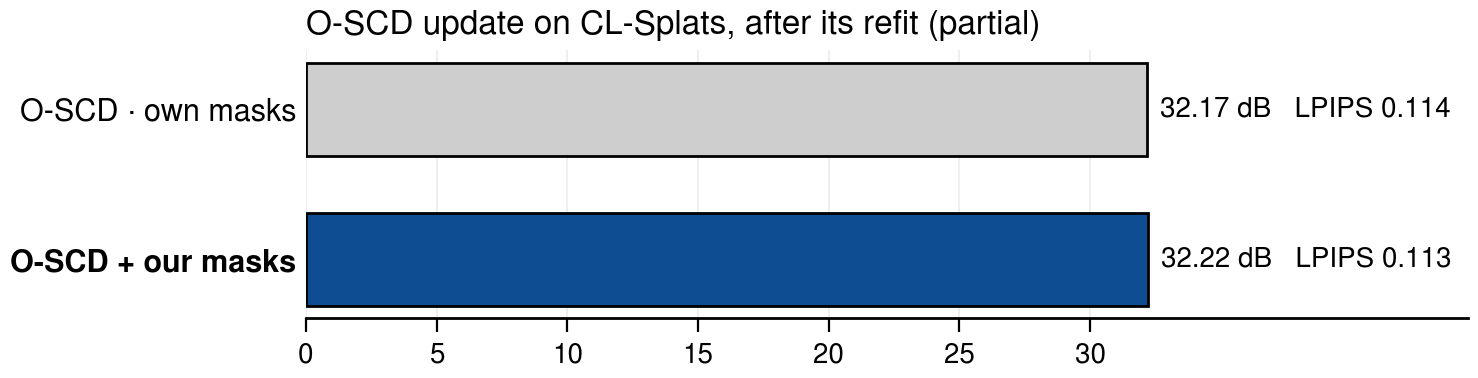
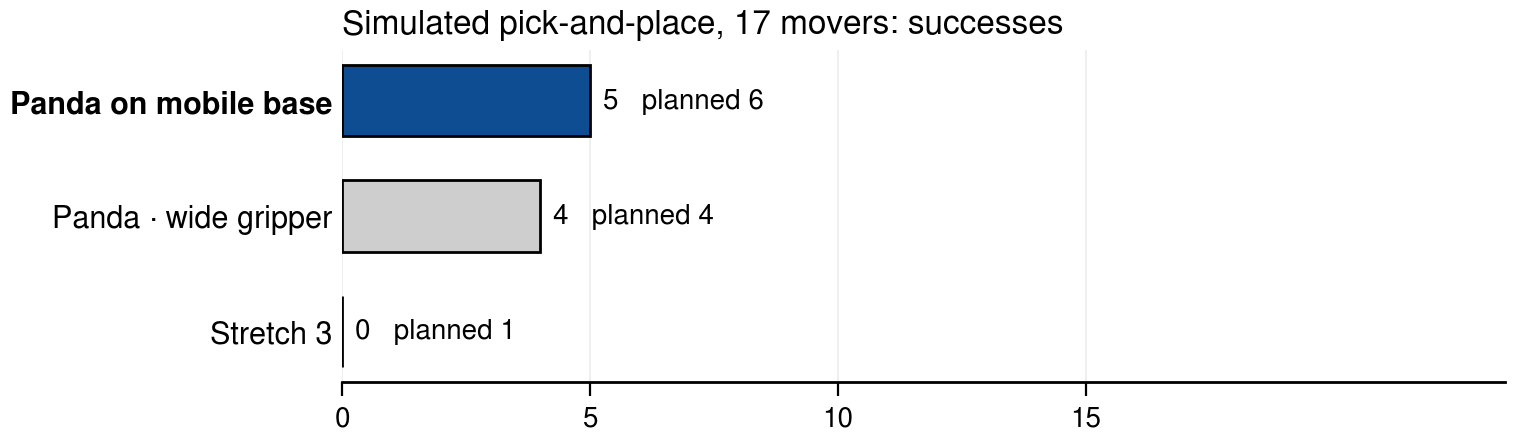
- Scene update: O-SCD's updater is better with our masks than its own before its refit (PASLCD +0.5 dB, CL-Splats +2.5 dB). Robot: mobile Panda picks and places 5 of 17 moved objects in sim (Stretch 3: 0).
Paper figures: object poses
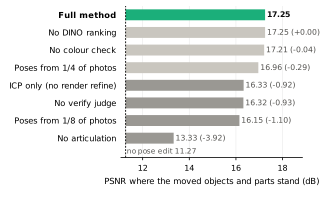
Print size (3.5 in, 7 pt). SVG versions with editable text: pose_ladder.svg, pose_ablation.svg, pose_per_object.svg.
Ablations and baseline checks (tables)
- Detection, one part of the protocol at a time (all 20 PASLCD instances)
- Judges: repeat run, no hints, agent alone, smaller models, 4-min splat, O-SCD on the same 5 scenes
- O-SCD + SAM3 / DINO refinements: none beats raw O-SCD
- O-SCD and O-SCD++ on our Gaussian splat (same representation; filled in as it runs)
- Pose step ablations, geometric check vs after-change scans, pose vs O-SCD and 3DGS-CD
Change detection
Mean F1 of the binary change masks at the evaluation views, each benchmark scored with its own script; IoU printed beside each bar. Every baseline is shown at its best labeled variant.
Object poses
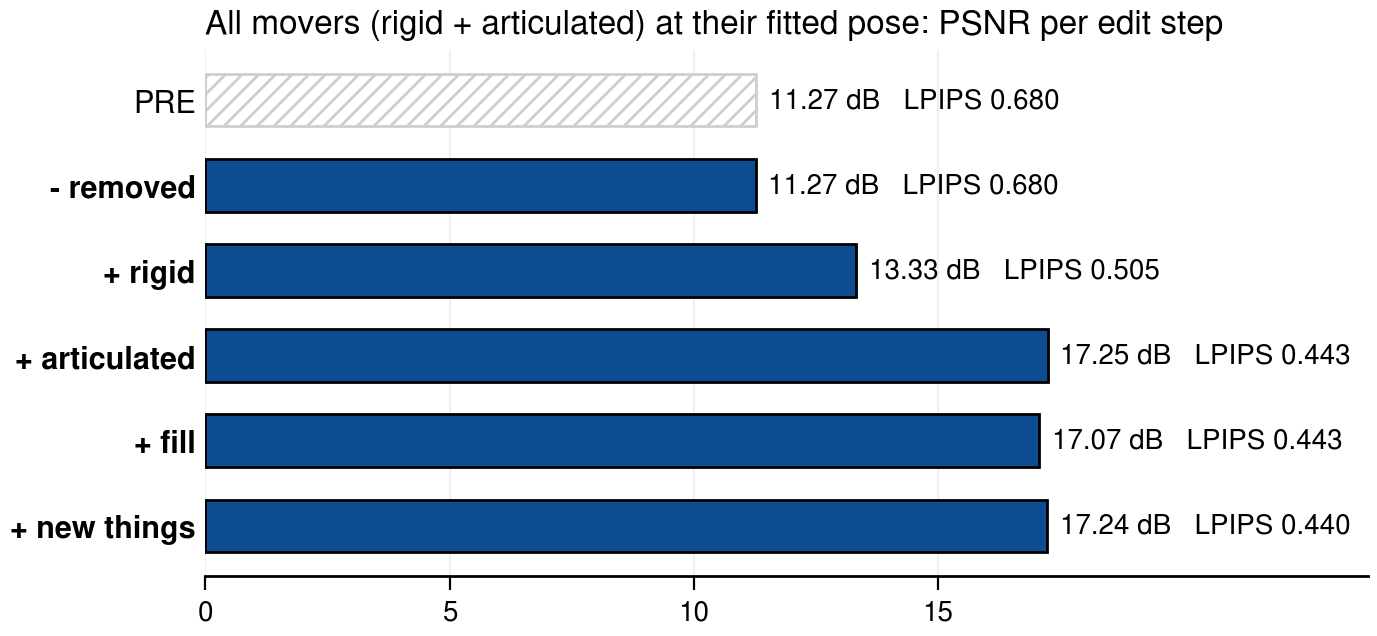
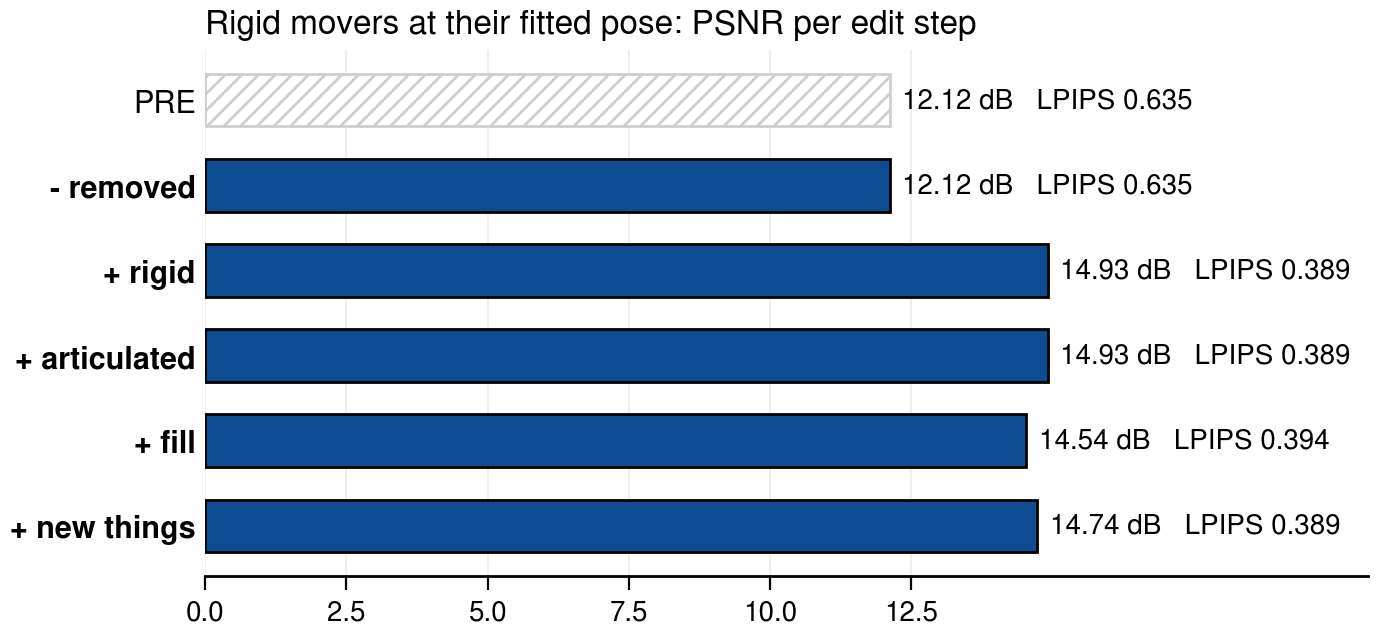
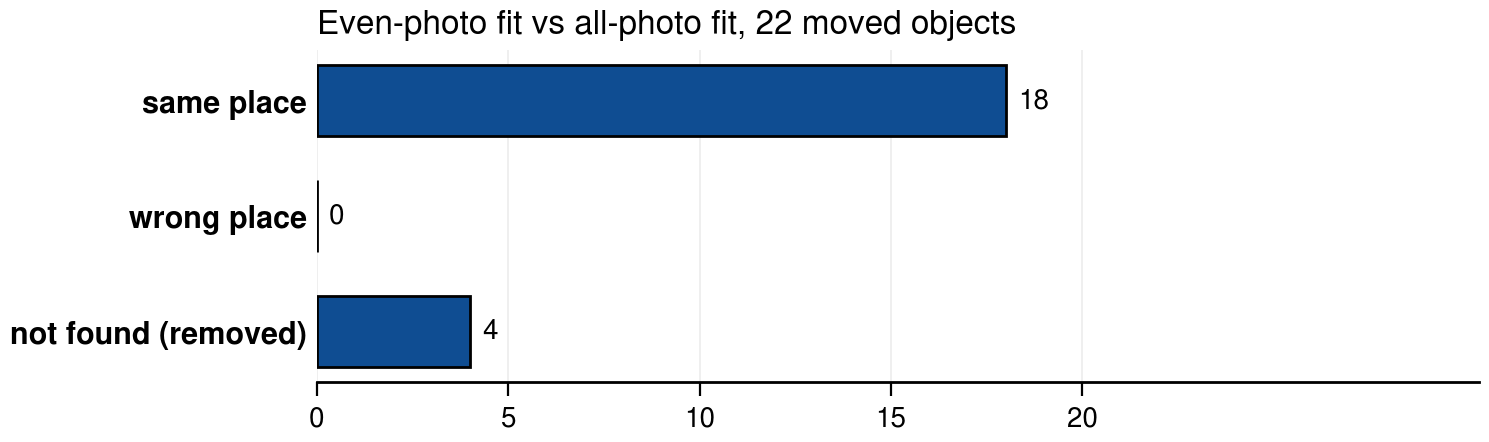
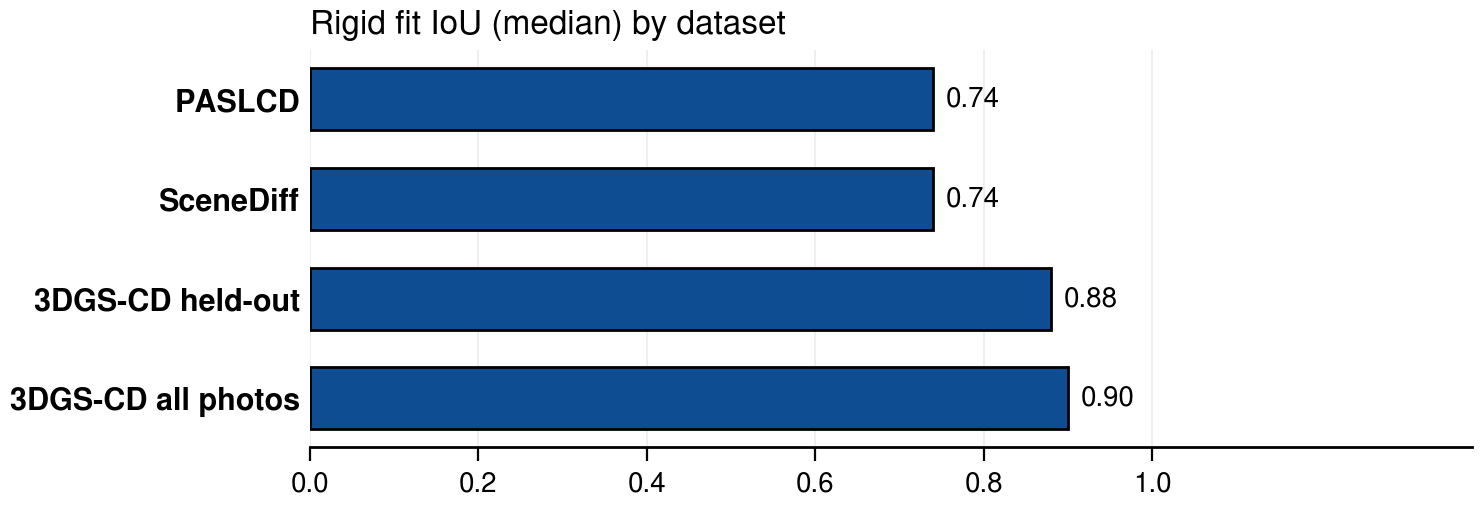
The scene before the change is edited one kind of decision at a time. Poses are fitted on the even photos after the change and scored on the odd ones.
Scene update
O-SCD's own update pipeline with its change masks and with ours, scored by its own script on held-out photos, full image.
Simulated robot
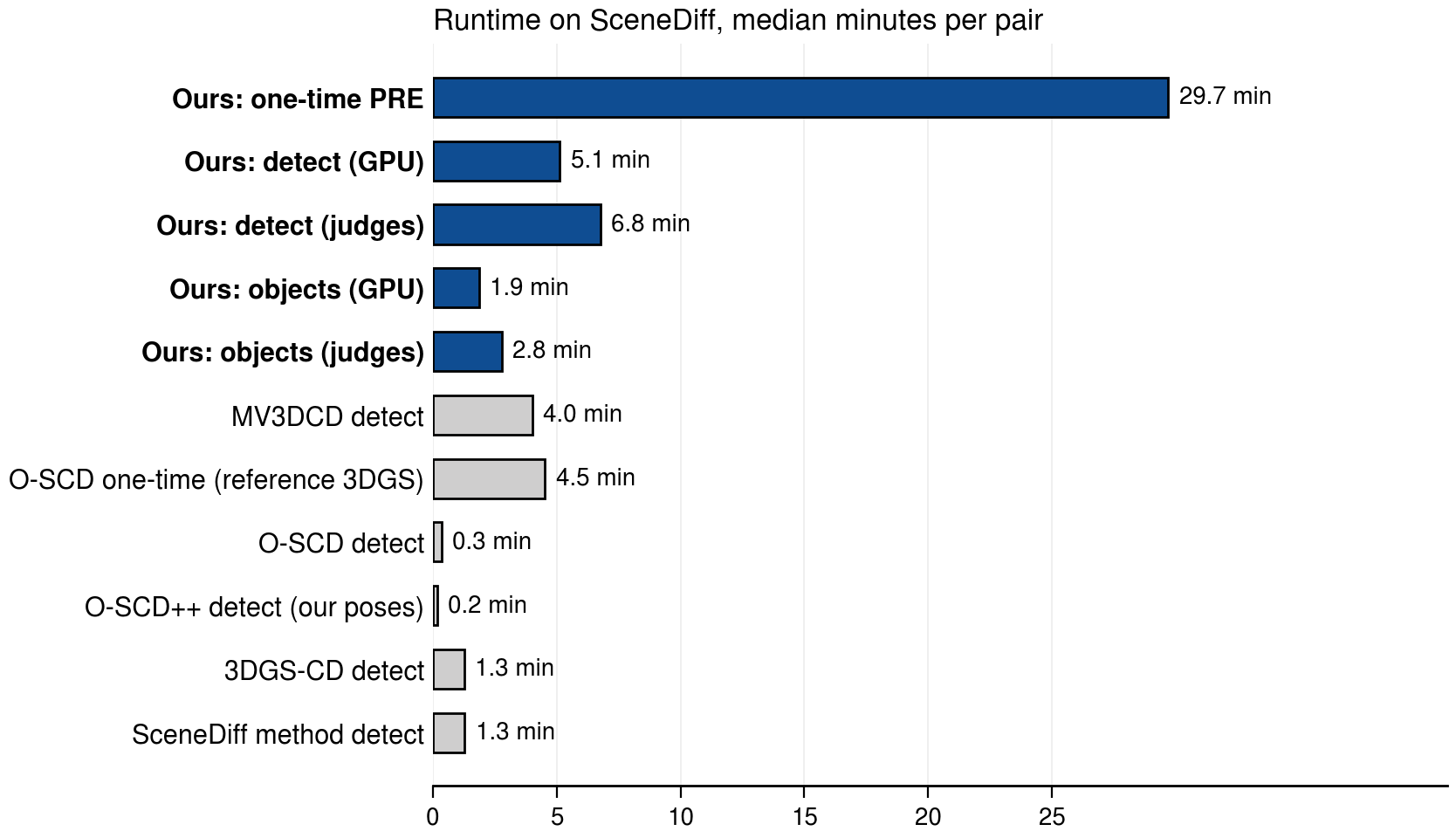
Runtime